Thursday, February 17, 2011

The Art of the Color Wheel

Color has always been the main focus of my jewelry designs. Mixing and matching different colors can drastically effect the overall concept. From decorating your home to selecting an outfit, color should be considered. 

Here's a look at the color wheel created by Johannes Itten that might have you looking at color a bit differently. 


How the Color Wheel Works
Creative use of color has always been a hallmark of artists and skilled craftspeople. The Color Wheel lets you use basic color theory by quickly and easily determining each type of color relationship. Johannes Itten developed the perfect visual tool: a 12-color wheel. With his color wheel, it is fun and easy to develop color schemes that work.

The wheel starts with the three primary colors equidistant from each other: yellow, red and blue. 
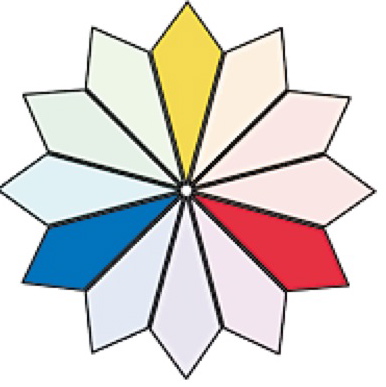
Mixing two primaries creates a secondary color. The three secondaries are: orange, violet and green.

Mixing a primary color with a nearby secondary color yields a tertiary color. The six tertiaries are: yellow-orange, red-orange, red-violet, blue-violet, blue-green and yellow-green. 

Four Color Schemes
Monochromatic Scheme: The most simple way to create a beautiful piece is to use the same color throughout, but by using lighter and darker elements. Shown are various shades and tints of green.


Analogous Scheme: Always pleasing to the eye are colors that are close to each other on the wheel, like yellow to orange to red-orange.


Complementary Scheme: Nothing stirs excitement like the eye candy, high contrast effect of a complementary color scheme. Complementary colors are directly opposite each other on the color wheel and are always stimulating if their hues are pure. A beautiful, more subdued harmony can be achieved by using light or dark complementary pairs.


Split-Complementary Scheme: This scheme combines the effect of the powerful complementary scheme with a variation on the analogous scheme. It offers intriguing possibilities in complexity and sophistication. Determine a key color. Then go directly across the color wheel to find its complement. Instead of the complement, use the two colors that you find next to it. In this example the key color is green. Instead of green's complement (red), its split-complements were chosen: red-orange and red-violet. 


Friday, February 11, 2011

Jewelry Marking 101 Sneak Peek

Kerry Elizabeth is hosting a beginners jewelry making class Sunday, February 13th at 2:00 PM. Here's a sneak peek at what you're in for!

  • Learn what tools and supplies you need to get started. 

  • Practice the basic techniques of jewelry making.  Glass beads and base metal findings will be supplied for you to create your own piece. 

  • Along with the piece you created, you will be taking home a stringing tutorial to keep you on track.  
Need some more inspiration? We have created jewelry kits filled with gemstones and findings in an array of color stories.

Stop by Penn's Place at 206 Delaware St in Historic New Castle, DE on February 13th at 2:00 PM. Bring your ideas and we will supply the rest!

Wednesday, February 9, 2011

"Green" Jewelry Care Tip

The fantastic jeweler Faulkner Jewelry Design from Middletown, DE posted a great jewelry tip in the February newsletter that I just had to pass along.


This month's tip illustrates a "green" way to Reuse, rather than Reduce or Recycle. Do you have one earring from a favorite pair? Has it's wayward mate disappeared unexpectedly from sight? Is it lost in your car, purse, or caught in your scarf or hair?

Here's an idea to make use of the orphan earring. Use jewelry pliers to detach the lone earring from the earwire (the part that goes through your ear) and set the ear wire aside. Then thread the loop at the top of the earring into a small chain, ribbon, or silk cord. If you use a ribbon or silk cord, just tie it behind your neck. If you find that loop at the top of the earring is too small to thread over the closures on the chain, you may need to add a small ring, called a jump ring. 

And now you know a simple way to reuse that lone earring!

Visit Faulkner Jewelry Design at their two studio locations or visit them at www.faulknersterlingdesign.com

115 E. Redding St
Middletown, DE 19709

Penn's Place, Studio 2
206 Delaware St
New Castle, DE 19720

Monday, February 7, 2011

Love is in the Air

As you may already be aware, every gemstone is unique and represents a different type of healing power, energy, or luck. There are also many love gemstones. I have compiled six stones that will boost your relationships and your love life.  

Rose Quartz
1: Rose Quartz is the stone of universal love. Place this stone under your pillow and your  marriage can have more sparkle and fire!


2. Lapis represents tenderness, sympathy and love. Those using the stone will be known by their powers of love and affection and can generally win over others through the powers of love. They would also find that they can transmit love to others with ease and confidence. 

3. Kunzite opens the heart to all forms of love. It can also be a sign of new life and is sometimes regarded as a symbol for pregnancy.

Rainbow Moonstone
4. Rhodonite vibrates love. Just holding this gemstone promotes relaxation and brings a sense of well-being. 

5. Sapphire has long symbolized truth, sincerity, and faithfulness.  

6. Moonstone is called the gem of hope. It can bring success in both love and business matters.


Thursday, February 3, 2011

A Jewelry Shopper's Checklist

Wether you are treating yourself or a special someone to a new piece of jewelry it is important to shop around. Compare price, quality, and customer service. Use the checklist below when shopping. 


  • Shop with companies you know or do some homework to make sure the company is legitimate.   
  • Ask about the return policy before you buy.
  • Check for the appropriate markings on metal jewelry.
  • Ask whether the pearls are natural, cultured or imitation. 
  • Ask whether a gemstone is natural, laboratory-created or imitation. 
  • Make sure the sales receipt includes any information you relied on when making your purchase such as the gem’s weight or size.